When we talk about dumplings, we’re not just talking about one dish but a variety, each with its own unique doughy outer layer and a filling.
The thing with dumplings is that there are so many different kinds all over the world. And beyond being a beloved tasty comfort food, each one has a rich cultural history.
If you’re a dumpling lover, this piece is for you. Here, you’ll learn about some of that history, culture, and other cool facts about dumplings you’ve probably never heard before.
An ancient Chinese medicine man, Zhang Zhongjing, is believed to have made the first Chinese dumplings during the Han Dynasty. These ear-shaped dumplings were called tender ears and were made as a remedy for cold ears.
Dumplings were once considered a luxury food across Asia, reserved for special occasions or elites.
The first time dumplings were mentioned in literature was in a poem by Shu Xi, written about 1700 years ago.
Archeologists uncovered dumpling remains believed to be over a thousand years old in a tomb in the Xinjiang region of China.
The word ‘dumpling’ is much newer than the food itself and was first recorded in the 1600s. It likely originates from the German word dump, meaning a dough-like lump.
Dumpling dough can be made from various starchy ingredients, such as wheat, rice, potatoes, or even leftover bread. Fillings commonly include a mixture of meat, veggies, herbs and spices, fruits, and sometimes nothing at all.
Dumplings are prepared in various ways, including boiling, steaming, baking, or frying, depending on regional styles.
Traditionally, Chinese dumplings are purse-shaped (bao), or crescent-shaped (gao).
Dumpling cooking styles differ across China, with those in the North usually boiled and those in the South steamed.
Lithuania’s national dish, Cepelinai, are giant potato dumplings named after zeppelins because of their shape. They’re stuffed with pork or cheese, boiled, then topped with sour cream and bacon sauce.`
The ingredients used to make dumpling dough also vary by location and the availability of resources. In Northern China, where wheat is abundant, dough is typically made with wheat, while in the south, rice is more common.
Dumplings are one of those universal dishes, with almost every culture having its own variety. There’s Jiaozi from China, Gyoza from Japan, Pierogi from Poland, Khinkali from Georgia, and Banku from Ghana.
Several countries around the world have dumplings as their national dish. For example, Pelmeni is the national dish in Russia, Bryndzové halušky in Slovakia, and Varenyky from Ukraine.
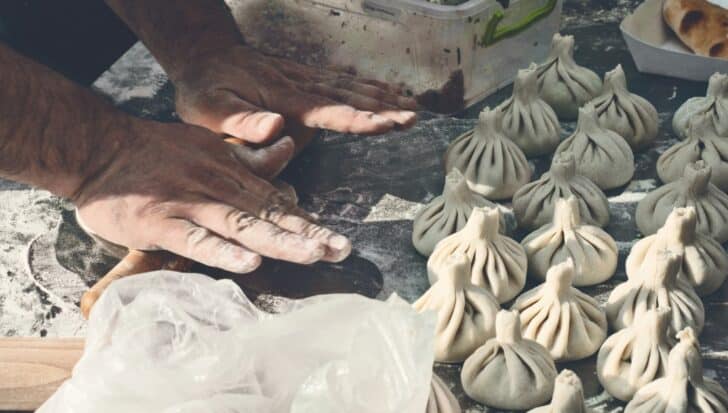
Georgia’s Khinkali are large soup-filled dumplings with twisted tops. Traditionally, they’re boiled in vast cauldrons over an open fire, and etiquette says you bite a hole, sip the broth first, then eat the rest.
Historians believe that the practice of making dumplings originated as a means to preserve food and stretch limited resources to feed more people.
Dumplings have their own festivals all over the world. Some of the popular ones include the Dragon Boat Festival in China, the Double Fifth Festival in Malaysia, the St. Johann Dumpling Festival in Tirol, Austria, and the World Dumpling Fest in Chicago, USA.
The St. Johann Dumpling Festival boasts the longest dumpling table in the world, measuring a whopping 1,952 feet (595 meters). Each year, over 26,000 dumplings are served to festival attendees.
Although dumplings in China can be enjoyed at any time, they’re one of the main traditional dishes at Chinese Lunar New Year celebrations.
Chinese New Year dumplings are seen as a symbol of wealth and prosperity in the coming year, as they resemble the small, forged lumps of gold or silver used as currency in ancient China.
In India, sweet dumplings called modak are filled with coconut and jaggery (an unrefined cane sugar) and offered to the elephant-headed god Ganesha during festivals.
Brides are given a half-cooked or raw dumpling during traditional Chinese weddings. This symbolizes fertility in marriage.
China’s green qingtuan dumpling gets its color from Chinese mugwort or barley grass, and features a sweet red or black bean paste filling. They’re made to honor the dead during Tomb Sweeping Day or as a lovely spring snack.
Dumplings have been a Southern comfort food in the U.S. since at least 1878, most famously in chicken and dumplings. These dumplings are usually plain dough, either dropped into broth or rolled and cut into strips.
In 2008, Yunlin County in Taiwan set the Guinness record for the largest rice dumpling at 2,901 pounds (1,316 kg). Its filling included rice, meat, prawns, mushrooms, squid, peanuts, ginger, and spring onions.
In 2017, Isaac Harding-Davis from Australia achieved a world record for the most dumplings eaten in two minutes, finishing 30 in Sydney.
In 2024, a viral trend saw tens of thousands of Chinese students bike 31 miles (50 km) overnight to Kaifeng for soup dumplings. The hungry cyclists packed a six-lane highway, eventually blocking traffic until authorities got involved.
National Dumpling Day is observed every year on September 26, and started in the US before spreading worldwide.
Other holidays dedicated to celebrating specific kinds of dumplings include National Bao Day on August 22, National Apple Dumpling Day on September 17, and National Pierogi Day on October 8.
One special dumpling, Poland’s pierogi, even has a patron saint, Saint Hyacinth. It’s believed the saint restored their crops after a thunderstorm destroyed them, and in appreciation, the people made him pierogi.
68% of the United States’ pierogi consumption occurs in the wonderfully named Pierogi Pocket, which covers parts of Michigan, Ohio, Indiana, and Pennsylvania.
There’s a dumpling-themed museum in Dalian, Northeast China, where you can learn firsthand about the history of dumplings, make your own, and, most importantly, consume them en masse.
Dumplings exist in every corner of the world, each shaped by local culture and tradition. They can stand for wealth, luck, or simply comfort, but above all, they bring people together.
Whether it’s Jiaozi in China, khinkali in Georgia, or modak in India, each dumpling carries its own story of place and tradition.
Now, who’s ready to try to eat every dumpling from around the world?