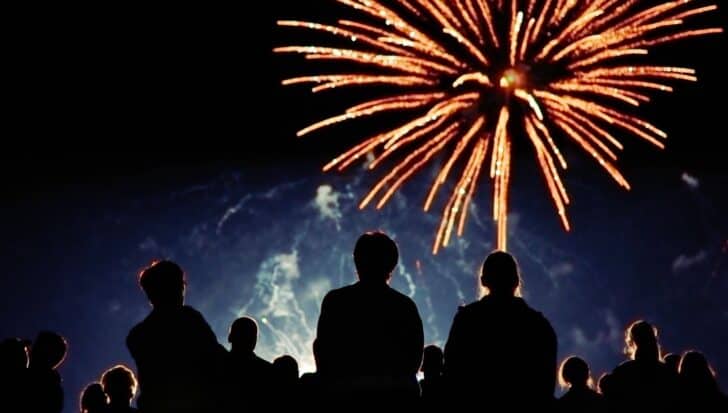
All over the world, people gather to watch dazzling fireworks displays on special occasions, like New Year’s Eve and the Fourth of July.
But have you ever wondered what’s behind the thunderous booms and dazzling colours that light up the night sky at the strike of a match?
Why do some sparkle, sizzle, or paint stars in the sky? Keep reading to find out.
When were fireworks invented?
Experts believe that the earliest form of fireworks dates back to around 200 BC, in ancient China.
These early versions were simple: bamboo stalks were tossed into the fire, which would explode with a loud bang when the pressure inside became too high.
Fast forward to sometime around 600 to 900 AD, Chinese alchemists invented gunpowder by combining charcoal, potassium nitrate, and sulfur.
This mixture laid the foundation for more advanced fireworks.
The next generation of fireworks was initially made by loading gunpowder into bamboo sticks, and later, into paper tubes.
During the Song Dynasty (960-1279 AD), fireworks became widely used for spiritual and celebratory purposes.
They were believed to ward off evil spirits and were used in weddings and birth announcements.
Over time, however, fireworks evolved to become a popular form of entertainment. As a result, they were incorporated into festivals and ceremonies.
Around the 13th century, travelers and traders returning from China introduced fireworks to Europe, where they gained popularity quickly.
From there, fireworks were again carried to the New World by explorers, marking the beginning of the history of fireworks in America.
A year after the signing of the US Declaration of Independence, Philadelphia hosted the first Independence Day fireworks celebrations on July 4, 1777.
What gives fireworks their spectacular colors?

At first, fireworks were mainly one color, orange. Over the years, alchemists figured out how to add extra colors. The science behind it is wonderfully simple, too!
When exposed to high heat, many metals will burst into a colorful flame. So, all the pyrotechnicians had to do was add specific metals to the gunpowder mix to achieve the desired effect.
Classic silver or white fireworks typically contain titanium, magnesium, and zirconium. Adding strontium gives fireworks a brilliant red color, while sodium makes them yellow, and copper turns them blue.
But here’s where things get more interesting. Making colorful fireworks is a bit like a painter trying to get the perfect shade by mixing colors.
In this case, pyrotechnicians combine different metals to create specific colors. For example, combining strontium and copper creates a purple burst, while strontium and sodium give you orange.
How are fireworks made to explode in specific shapes?

Fireworks that create shapes like hearts, stars, or faces in the sky are truly impressive. But the real magic lies in how they’re made to create that effect.
The secret is in the structure of the firework. These special fireworks contain multiple small pellets composed of the explosive material, arranged in a specific shape within their shell. Cardboard inserts are often used to help keep the stars in position.
So, when the firework is launched and burst in the sky, the stars explode in the same shape in which they were arranged.
The only catch is that you have to be perfectly aligned with the fireworks to see the image they form in the sky.
To ensure that everyone gets a glimpse of the show, pyrotechnicians typically launch fireworks from multiple angles.
Now, there’s a second way to create images with fireworks, but it’s a bit more complex.
This involves using set pieces. These are built into the ground with multiple lances (individual small fireworks of various colors) arranged in a specific pattern.
Once it’s time for the display, all the lances are ignited at once and burn together, creating a large image.
This technique, although more tedious, is preferred for complex designs, such as making a giant firework display of the US flag.
Can fireworks randomly go off on their own?
In short, fortunately not! By design, fireworks require an external source of ignition, such as a flame or any other device that activates the fuse.
As long as you store them away from sparks, heat, or any possible sources of ignition or flammable materials, they should be safe.
Moisture and direct sunlight can also cause dud fireworks, so storing them in an airtight container with moisture-absorbing packets is recommended.
Fireworks have fascinated us for centuries, and it’s all thanks to a clever mix of chemistry, craftsmanship, and tradition.
When ignited, metal compounds produce colors, and the arrangement of explosive pellets creates shapes.
So, the next time you’re watching a glorious fireworks display, impress your friends with an explanation of how it all works and watch their eyes light up!