Any number that is multiplied by one equals that number. Likewise any number divided by one also equals that number.
The number one can only be divided by itself and is the only number that cannot be divided by any other.
This means that the number one is not a prime number, although it has been widely considered as a prime number in the past.
A prime number is defined as “a positive integer with exactly two positive divisors: 1 and itself”.
So by this logic one is not a prime number as its only divisor is itself.
One is an identity element in multiplication.
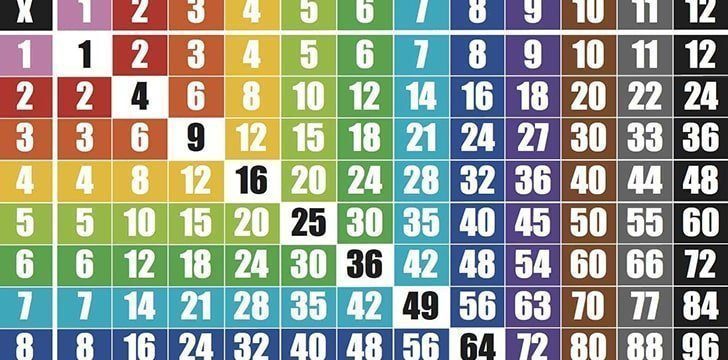
For example, 8 multiplied by 1 equals the same as 1 multiplied by 8 which equals 8.
Because of this mathematicians refer to one as the multiplicative identity (the reflexive identity of multiplication).
There are many different terms for things featuring only one of something.

For example, the term for a creature with one eye is a “cyclops”, and the term for a camel with only one hump is a “dromedary”.
There are also many things that feature the prefix “uni”, meaning one, at their beginning.
A few common examples of such words are unicycle, uniform, and unicorn.
The number one also represents many different things within numerology, from unity to everything, as well as the beginning and God.
Supplements of the number 1.

There are some things that supplement the number one as something else, rather than its numerical form.
One such example of this would be the way an Ace in a deck of playing cards is the card representing the value of the number one.
However, in French playing cards the Aces are marked with a “1” rather than an “A”.
The number 1 in Rating Schemes.
When used in numerical rating schemes, the number one is either the highest or lowest score.
In Germany and Austria, one is the grade for “very good”.
It is the best of six possible grades in Germany and the best of five in Austria.
In the Netherlands, one is the lowest grade and ten is the highest.
One is also the lowest grade in Poland where six is the highest.
Benford’s Law:

Benford’s Law is a mathematical law, also known as the first digit law, the first digit phenomenon, or leading digit phenomenon.
The law states that in lists of data, the number one occurs with a probability of 30%.
This is much greater than the expected 11.1% (one in nine).
This has proven to be the case within all different types of data compilations from the day’s stock quotations to tennis tournament scores!
A system based upon Benford’s Law was devised by a Dr. Mark Nigrini in order to help crack fraud cases in Brooklyn, New York.
The idea underlying Nigrini’s system said that if the numbers in a tax return more or less match the frequencies and ratios set down by Benford’s Law, then they are probably real.
But if this data were to feature a set of numbers that significantly differ from those predicted within Benford’s Law, the data is most likely fraudulent.