Known for their unique, three-horned heads, Triceratops are among some of the most fascinating creatures to ever walk the Earth.
Each Triceratops fossil found tells us a story, and with enough pieces of the puzzle, a picture of what life was like back in the land before time.
Join us as we dig deep to uncover facts about Triceratops you have never heard of.
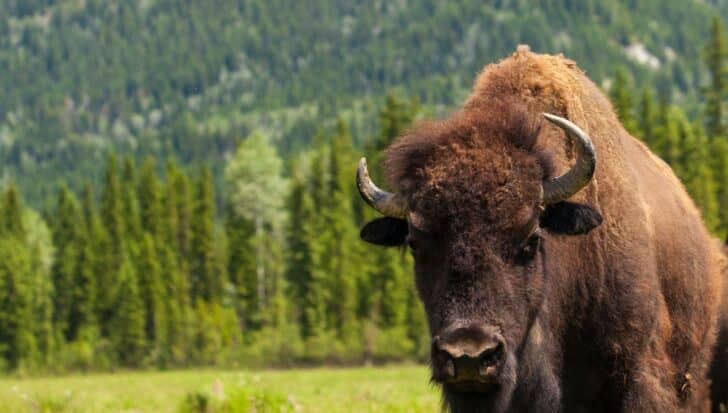
The first Triceratops fossils were thought to be bison horns.
In the spring of 1887, George Lyman Cannon unearthed a pair of giant horns in Colorado. He quickly sent them to American Paleontologist Othniel Charles Marsh for identification.
But at first glance, Marsh mistook them for the horns of an ancient species of giant bison.
As time passed, more fossils turned up in the same region, and Marsh realized he’d made a mistake.
Those horns didn’t belong to a bison but were actually from dinosaurs, which we know today as Triceratops.
Triceratops fossils are among the most commonly discovered in North America.
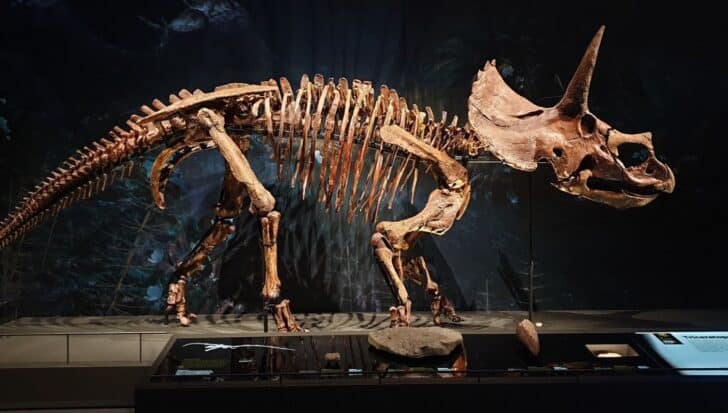
Roughly 65 million years ago, during the late Cretaceous period, Triceratops roamed freely across North America. So, it’s no surprise that most of their fossils are found there.
If you’re hunting for Triceratops fossils in the US, you might want to check around Colorado, Montana, North Dakota, South Dakota, and Wyoming.
Outside of the US, fossils have been found up in Alberta and Saskatchewan, Canada.
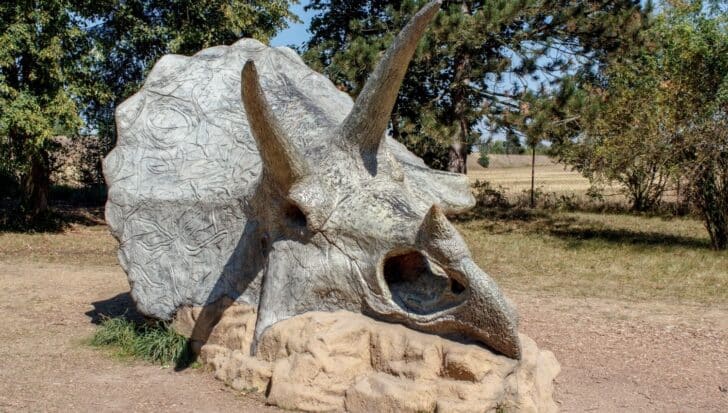
Triceratops means three-horned face.
When O.C. Marsh finally realised Triceratops weren’t some long-extinct bison, he had to come up with a new name.
“Triceratops” was coined, derived from the Greek language, and the new dinosaurs had a name!
For the Triceratops, their horns were a multipurpose tool, whether to fight rivals in fierce head-to-head combat, help defend against predators, or just to impress potential mates!
Baby Triceratops’ horns are straight and small but change as they grow. When they become adults, the horns on their brow curve forward while the lone nose horn stays straight.
Their frilled necks served as a shield.
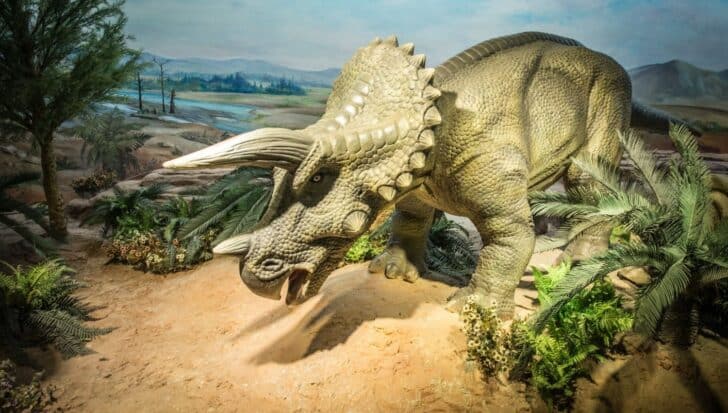
If you’ve ever seen a photo of a Triceratops, its bony neck frill is probably one of the first things you notice. Made of solid bone, it was one of the Triceratops’ most crucial defense tools.
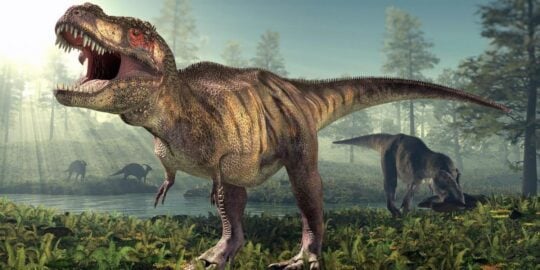
The shape and size of the bony frill made it difficult for predators like the Tyrannosaurus rex to bite through to the neck.
It was also thick enough to absorb the impact of head-to-head fights with other Triceratops.
According to scientists, the Triceratops’ bony frill also had other uses besides protection, such as attracting mates.
Triceratops had a sharp, hooked beak for shredding plants.
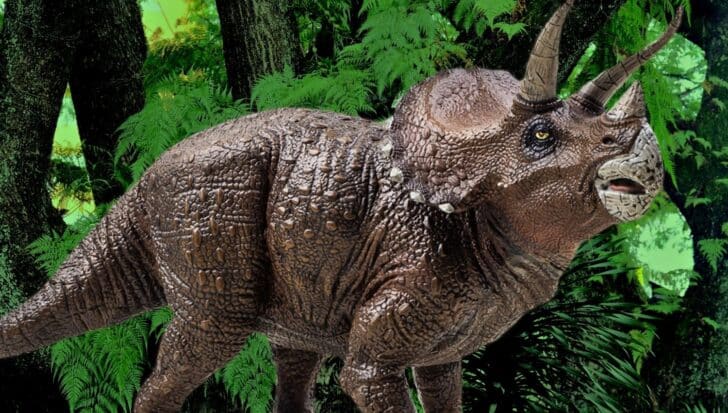
You might expect at least a huge jaw lined with sharp fangs for this massive dinosaur. But that’s not the case at all for the Triceratops.
Instead, they had something unexpected: a strong curved beak that looked much like the beak of a parrot!
While this might not appear as intimidating, they were everything a Triceratops ever needed, as their beaks could easily snip and slice through fibrous plants.
They had up to 800 teeth.
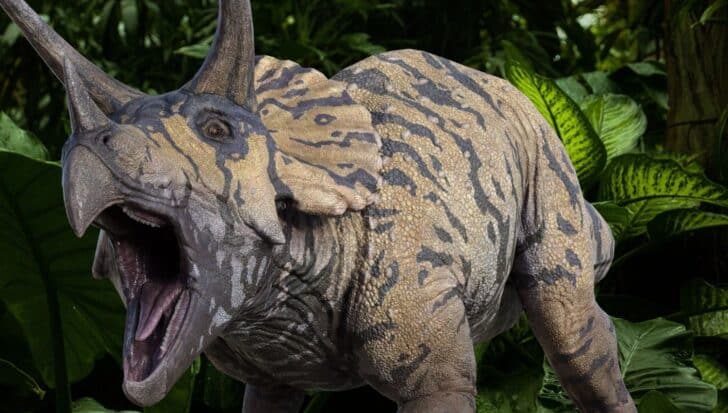
Triceratops teeth are arranged in groups called batteries. Each battery is made up of 36 to 40 tooth columns, each containing three to five teeth stacked vertically.
As older teeth get worn out from persistent chewing, newer ones grow in from under to take their place.
Their teeth are super strong and designed to withstand much chewing before getting worn out.
To compare, our teeth as humans have three layers, and other reptiles like crocodiles have just two.
They were roughly the same size as an elephant.
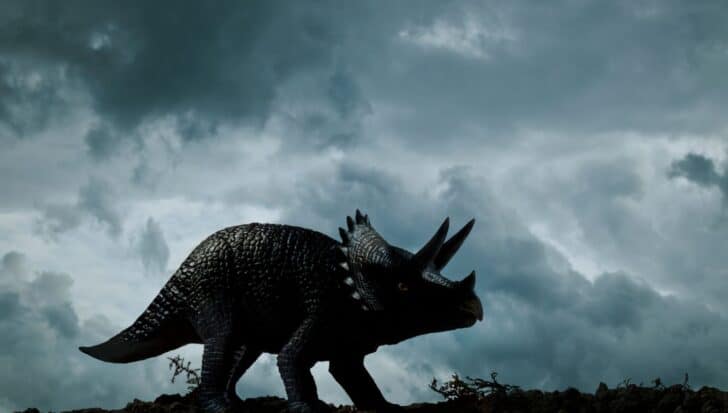
Only one word adequately describes the Triceratops, and it’s humongous.
These gentle giants were among the largest dinosaurs to walk the earth with their thick limbs and stocky, muscular bodies.
A mature adult could grow to 26 to 30 feet (8 to 9 meters) long and weigh a whopping 6.6 to 11.0 US tons (6 to 10 metric tons).
A Triceratops head can make up to one-third of its total body length.
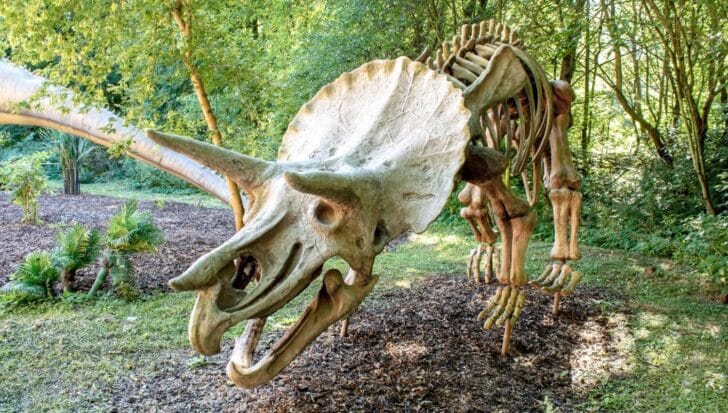
One of the largest Triceratops specimens unearthed by scientists was 26 ft (8 m) long, yet the skull alone measured about 6.6 ft (2 m) wide.
Triceratops’ heads are so large, in fact, that they’re considered to be one of the largest skulls of any known land animal.
Thankfully, Triceratops have special adaptations to help them carry their heavy heads.
Their neck bones are fused to one solid piece called the syncervical vertebrae to carry the weight. They also have super strong neck muscles for extra lift.
They were strictly plant eaters.
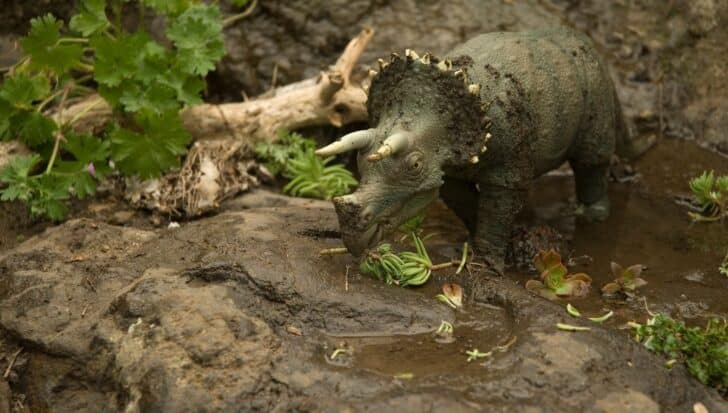
Meal time for the average Triceratops meant a feast of ferns, palms, and other low-lying plants. Now, this didn’t mean that trees with tall branches were off limits.
With their mighty horns and sheer strength, they could bring down any tree they desired just to get to the juicy leaves.
With all that chewing, it’s a good thing they had so many sets of teeth!
A Triceratops and a T. rex fossil were discovered locked together in eternal combat.
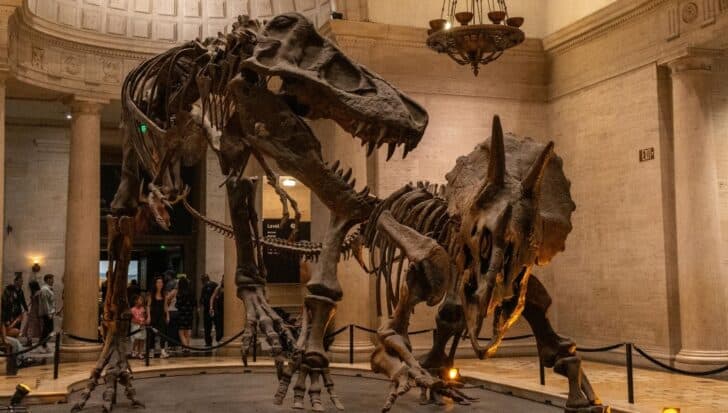
This fossil, now famously called the Dueling Dinosaurs, was found in 2006 in the Hell Creek Formation of Montana, USA.
The two dinosaurs had multiple injuries, including a T. rex tooth lodged in the Triceratops. This suggests they faced each other in an epic fight shortly before getting buried.
But what makes these fossils special is how well preserved they are. They contain not just bones alone but skin impressions, internal organs, and even their recent meals.
Triceratops are one of the most popular dinosaurs in the world, and it’s easy to see why!
While their frilled necks and giant horns are impressive, the fact that they could stand their ground against the mighty T-rex is nothing short of impressive.
Next time you find yourself in a conversation about dinosaurs, be sure to chime in with your newfound Triceratops facts!